Stress is the algorithm
This morning's train reading

The Wall Street Journal today has another story about sleep. It explains why 5 am is not the right time for everyone. I liked it! Also: there are too many stories about sleep.
What I have learned, having read many such stories: figure out your chronotype and do what you can to align your life to it. Regularity > time in bed (But get at least seven). Minimize caffeine, booze and get lots of exercise. Hard to do!1
What intrigued me most about the piece though, was not about sleep, but stress:
“In a Gallup poll (April 2024), 57% of Americans reported they would feel better if they got more sleep but said their stress prevented that. Around 20% of respondents said they got five or less hours a night. A decade ago, it was 14%, and back in 1942 it was just 3%.”
These data mark a switch. The majority of Americans had reported feeling they were getting enough sleep for every year since 2001 when Gallup started asking the question. (In 1942, 59% of Americans said they slept eight hours or more. Now it’s 26 percent).
The culprit? Stress.
63% of Americans who say they need more sleep also report frequently experiencing stress. In contrast, only 31% of those who get enough sleep report the same level of stress. 32 point gap.
Frequent stress levels in the U.S. are at an all-time high (49%), rising 16 points over the last two decades. This upward trajectory in stress directly mirrors the downward trend in sleep hours.
American Academy of Sleep Medicine (AASM): 74% of Americans lose sleep specifically due to stress.2
Stress and sleep feed each other, which makes perfect sense, but
The American Psychological Association (APA) investigated the “vicious cycle” here: Stress and Sleep (APA)
-43% of adults report that stress has caused them to lie awake at night in the past month.
We think of sleep as a singular, lonesome pursuit, but it leaks outward. When we don’t sleep we snap and yell at the people we love.
Our sleep issue may not be that we have fewer hours to sleep but that the cognitive overhang is greater. According to the Henry Ford Health study mental rumination accounts for roughly 70% of why stress prevents people from falling asleep. Sleep fails not because night shrank, but because day never ends.
This is what I mean by stress is an algorithm. It’s taking away our ability to execute our own choices even when you’re alone in bed trying to rest. The system (stress) is making the decisions.
Look at this graph:
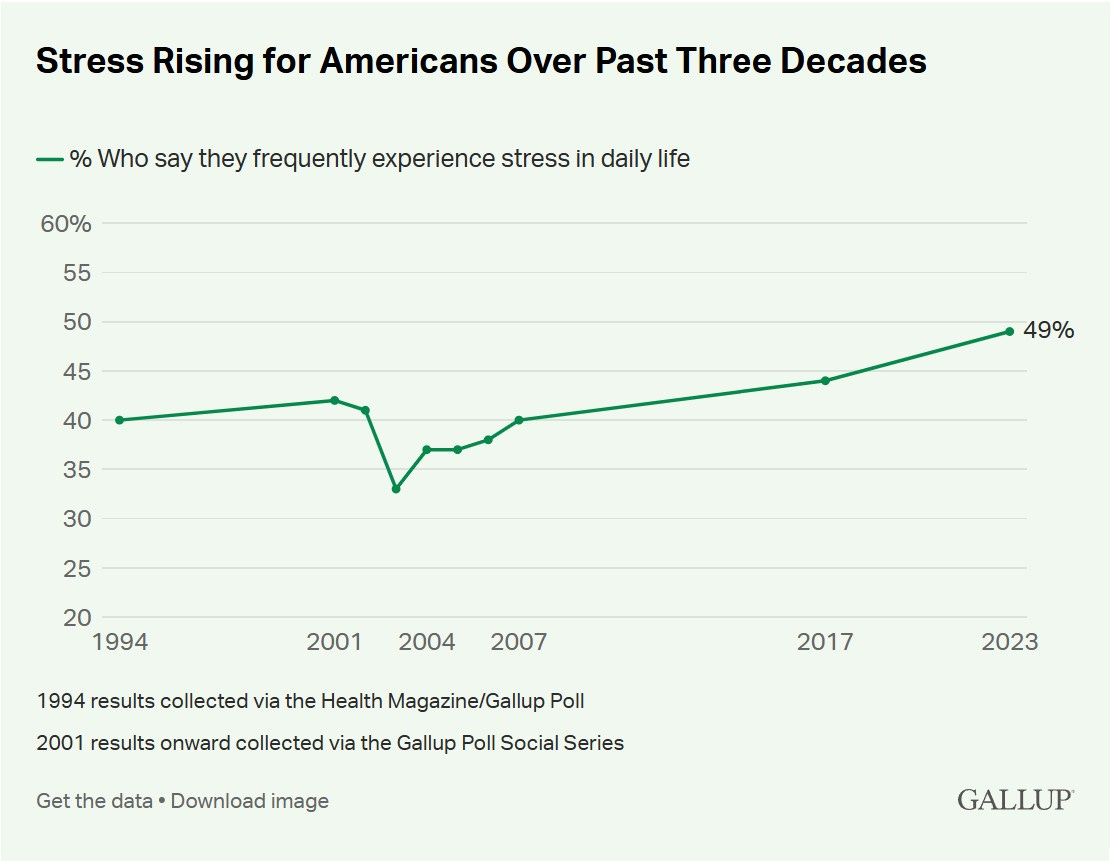
Unsurprisingly, the increase in stress picks up with the introduction of smart phones which makes agitation chronic.3 The blue light might suppress melatonin production, signaling your brain that it's still daytime and disrupting the circadian rhythm that tells you to sleep, but the content has to harm us too. Few people turn off their phone because they feel better? Most do so when they’ve had enough. (Unproved assertion!)4
These data confirm my existing beliefs!
Since the restraint piece I wrote for Slate in 2015 that didn’t run, I’ve been thinking about restoring attention sovereignty (TM). Stacking several of those hours at the end of the day might improve sleep. It’s not just what you consume, but whether your subconscious believes you are the one who made the choice in what to consume. 5
So, what do we do with this? I am not sure. Let me sleep on it. (Ed: Oh, come on, are you really going to leave that in? You’re right, what if I pretend I have an editor who would save me from a groaner like this to give me ironic distance but also allow the handful of people to have the low-key chuckle? We can’t all have gone to Harvard.)
I read these stories because I have a sneaking suspicion that my chronotype is misaligned. My heart rate decreases more when I go to bed closer to 12. That conflicts with rising at 6.
What amount of our stress that keeps us from sleeping is sleep stories telling us we need sleep?
UPDATE: Various readers point out that President Trump has increased stress for a lot of people. I wasn’t trying to scope all the reasons for stress, but since we talk about politics a lot, there is some evidence for that theory from this analysis of Trump’s first term: https://journals.plos.org/plosone/article?id=10.1371%2Fjournal.pone.0262022&utm_source=chatgpt.com.
Puzzler: Look at this chart. Why is there a steep drop from self-reported stress after the attacks of 9/11? I can imagine some ideas. Why do you think?
You might think you’re choosing to look at your phone, but you’re not.
So, so good…and I love the groaner.
I love groaners. I think empathy but also appreciation of family and friends around you. Like the holidays big time.