U.S. Action in Venezuela.
The authorization question in three points.

Why authorization matters: There will be a lot of discussion about whether the president’s action was authorized in Venezuela. This matters with respect to this specific action, but it also allows all of us to update our views on a central set of ideas about American government: As a constitutional matter, whether a president seeks authorization from Congress matters because it tells you what kind of force is being used and who gets to decide. At one end of the continuum are true emergencies—repelling an attack or rescuing Americans in immediate danger—where delay could cost lives, and the Constitution allows the president to act first because speed matters more than debate. Move beyond that narrow zone, however, and the logic changes: once force is planned in advance, sustained over time, or aimed at changing another country’s leadership or internal order, the decision no longer belongs to one person. The Constitution assigns it to Congress because Congress sits closest to the people, has to answer to them, and bears responsibility for decisions that commit the country, not just the commander in chief.
Its role is to force clarity before momentum takes over. A member of Congress has to stand up and explain: Is this about drugs? Is it about regime change? Are we occupying Venezuela for six months or six years? What happens if the generals don’t cooperate? What’s our exit? If a senator votes yes, and it goes badly, that vote is part of their record forever. That weight changes what gets said.
Right now, the administration is simultaneously claiming this is a law-enforcement arrest (minimal scope) and announcing we’ll “run the country” (open-ended commitment). No one with political skin in the game (cliche! Sorry!) is required to explain that contradiction. Rubio tells a Republican senator we “anticipate no further action”—but Trump is already talking about occupation. Without Congress, there’s no mechanism that forces someone to pick a story and defend it. The framing that survives is whichever one’s easiest to believe, regardless of what’s actually happening.
Farther along the continuum, when military action becomes open-ended or strategic rather than defensive, the risk isn’t just a bad outcome abroad but a structural one at home: without congressional authorization, there are no agreed limits, no shared ownership, and no clear point at which the country can say stop. At that point, bypassing Congress is no longer about urgency; it’s about control. That’s why authorization matters—not to slow necessary defense, but to ensure that the use of force reflects a national decision, grounded in public consent, rather than a presidential one.
Authorization: Vanity Fair article. The administration says the president was within his Constitutional rights as defined by Article II. That was not the White House Chief of Staff’s position recently. This is a passage from the recent Vanity Fair profile of White House Chief of Staff Suzi Wiles:
Over lunch, Wiles told me about Trump’s Venezuela strategy: “He wants to keep on blowing boats up until Maduro cries uncle. And people way smarter than me on that say that he will.” (Wiles’s statement appears to contradict the administration’s official stance that blowing up boats is about drug interdiction, not regime change.)
The administration's current legal defense (Article II) is undermined by their own Chief of Staff's public statement that the goal is regime change. Also, Wiles seems pretty certain a vote in Congress is required for what the president has now done:
…“We’re very sure we know who we’re blowing up,” she’d told me during lunch in November. “One of the great untold stories of the US government is the talents of the CIA. And there may be an interest in going inside territorial waters, which we have permission [to do] because they’re skirting the coastline to avoid getting [caught].” But Wiles conceded that attacking targets on Venezuela’s mainland would force Trump to get congressional approval. “If he were to authorize some activity on land, then it’s war, then [we’d need] Congress. But Marco and JD, to some extent, are up on the Hill every day, briefing.”
Polling Favor and Authorization: CBS News/YouGov (Nov 19–21, 2025): 70% oppose, 30% favor U.S. military action in Venezuela. CBS News
And the same CBS piece adds: “Three in four Americans” say Trump would need congressional approval first. CBS News
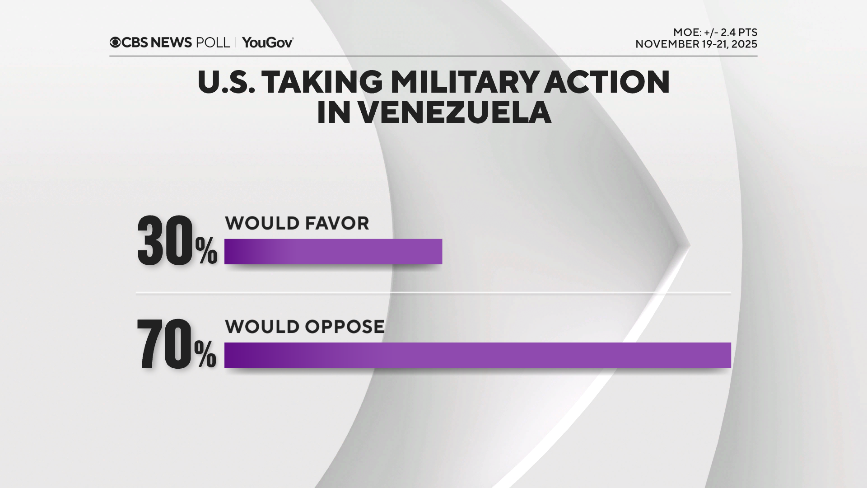
Those numbers don't tell you what Congress might have done if asked. They don't tell you what Americans might think if the administration had made the case upfront: "Maduro stole an election. Eight million people fled. He's destabilizing the region. We're going to remove him by force. Here's why we think that's in America's interest."
Instead, the administration acted first. And they acted at a scale that by Wiles’s own account—mainland strikes, occupation, regime change—requires Congress. So now we can’t know whether the public would have supported it if given an honest choice.
Hi John, love that you are here! Sad that you and Maurice had to leave cbs.. I’m boycotting cbs now. For that as well as not showing the 60 mins on that awful prison. Too bad we can’t send the Whole Regime there! Take care!🦋
I just emailed my two Democratic Senators and Congressional Representative. We can't let Trump and his incompetent administration ignore the rule of law for another year in the hopes the Democrats takeover. What are you doing to convince your Republicans colleagues that they must act now?